




![A final serving of golden British Flapjacks [Flapjacks Britanniques] on a plate.](https://elasdenis.com/wp-content/uploads/2026/03/British-Flapjacks-Flapjacks-Britanniques-0-400x301.jpg)
Creole Griot & Fried Plantains [Griot & Bannann Peze]
Print Recipe
Creole Griot & Fried Plantains is a traditional Haitian dish featuring marinated, boiled, and fried pork shoulder served with a rich, caramelized tomato Creole sauce and twice-fried crispy green plantains.
Dedicated to my parents
Svetlana and Oleg ❤️
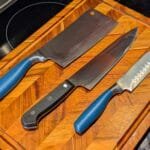
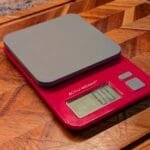
Equipments

Food processor or blender

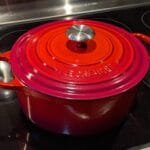
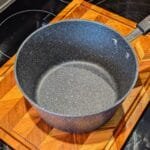
Dutch oven or heavy-bottomed pot
Air fryer
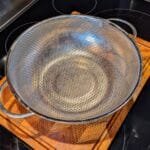
Strainer or colander
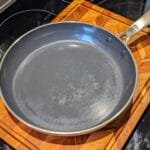
Frying pan heavy skillet

Ingredients
The Produce & Fresh Herbs
- 100 g scallions green and white parts, 1-inch pieces
- 50 g fresh parsley leaves and tender upper stems
- 20 g thyme fresh, divided into two 10g bundles
- 45 g garlic peeled and crushed
- 1 red bell pepper roughly chopped into 1-inch squares
- 1 green bell pepper sliced into thin strips
- 1 yellow onion sliced into thin half-moons
- 3 lime large, kept whole until ready
- 2 hot peppers Scotch bonnet, intact with stems
- 2-3 green plantains rock-hard and dark green
The Meat & Dairy/Liquid
- 1200 g boneless pork shoulder blade cut into 2-inch cubes, fat attached
- 900 ml chicken broth liquid stock, preferably low-sodium
The Pantry & Spices
- 156 ml tomato paste 1 small can
- 1 L frying oil neutral, like Canola or Peanut
- 1 Tbsp. extra virgin olive oil
- salt coarse kosher salt
- freshly ground black pepper ground
- 1 Tbsp. cloves whole
- 1/4 tsp. ground cloves powder
- 1 Tbsp. smoked paprika
- 1 tsp. garlic powder
- 1 tsp. Seasoning Salt Cool Runnings or Adobo
servings
Cook Mode
To prevent your phone from sleeping (screen turning off)
Instructions
The Epis
- To prevent the blender blades from jamming, load the wettest and softest ingredients first. Pour exactly 120ml (1/2 cup) of the 900 ml chicken broth into the bottom. Add the chopped 1 red bell pepper, the 45g of peeled 45 g garlic, the 100g of 100 g scallions, and the 50g of 50 g fresh parsley.
- Drop in 10g of the 20 g thyme sprigs, 1 tbsp 1 Tbsp. cloves, 2 tbsp freshly ground black pepper, and 1.5 tbsp salt.
- Start the blender on low to catch the ingredients, then quickly ramp up to high speed. Blend for a full 60 to 90 seconds until the mixture is a completely smooth, vibrant green puree with no visible chunks of garlic or cloves.
- While the blender is running on its lowest speed, slowly stream in the 15g (1 tbsp) of 1 Tbsp. extra virgin olive oil. Pulse it just until combined. This mechanical emulsion coats the chopped herbs in fat, preventing the Epis from turning brown in the fridge.
- Measure out exactly 1/3 cup of this fresh Epis for your pork. Pour the remainder into an airtight glass jar and store it in the refrigerator (it will keep for up to 3 weeks and can be used to marinate chicken or fish).
The "Chode" Method)
- Place your 2-inch 1200 g boneless pork shoulder blade cubes into a large mixing bowl or a perfectly clean stainless steel sink. Sprinkle the meat evenly with 2 tbsp of salt. Cut 2 of your 3 lime in half. Gripping the lime halves tightly, aggressively scrub every surface of the pork with the cut side of the fruit, squeezing the acidic juice over the meat as you work. This salt-acid friction breaks down surface proteins and neutralizes raw meat odors.
- Bring a kettle or pot with exactly 4 cups of water to a violent, rolling boil. Pour the boiling water directly over the raw pork. Using a wooden spoon, vigorously toss the pork in the hot water for exactly 30 seconds. The exterior of the meat will immediately turn grey and firm up.
- Drain the pork completely through a colander, shaking off excess water. Transfer it to a clean bowl. Pour your 1/3 cup of prepared Epis over the warm meat. Add 1 tbsp 1 Tbsp. smoked paprika, 1 tsp salt, and 1 tsp freshly ground black pepper. Use your hands to massage the paste deeply into the crevices of the meat for 2 minutes. The warmth of the blanched pork will open its pores, allowing the marinade to penetrate rapidly.
The Hydrolysis (Boiling the Pork)
- Transfer the marinated pork cubes and every drop of the marinade at the bottom of the bowl into a heavy-bottomed pot (like an enameled Dutch oven).
- Gently place 1 whole, unpunctured 2 hot peppers and 5g of 20 g thyme sprigs on top of the meat.
- Do not add extra water. Cover the pot with a tight-fitting lid and place it over medium heat. Let it cook for 35 minutes. The pork will release its own juices, creating a braising liquid. The heat will melt the tough collagen inside the shoulder blade, transforming it into tender gelatin.
- After 35 minutes, a fork should pierce the meat with minimal resistance, but the cubes must still hold their shape entirely. Do not let it boil until it shreds like pulled pork.
The Creole Sauce
- While the pork is boiling, place a medium saucepan over medium heat. Add 2 tbsp of 1 L frying oil. Once the oil shimmers, add 2 tbsp of your leftover jarred Epis. Fry for 2 minutes, stirring constantly until highly fragrant. Add the entire 156ml can of 156 ml tomato paste directly into the hot oil. Fry the paste for 2 to 3 minutes, scraping the bottom of the pan. The paste must deepen from bright red to a dark brick/rust color; this caramelizes the sugars and removes the metallic tin flavor.
- Slowly pour in the remaining 780ml of 900 ml chicken broth, whisking vigorously to dissolve the caramelized tomato paste and Epis into a smooth broth.
- Whisk in 1 tsp 1 tsp. garlic powder, 1 tsp 1 tsp. Seasoning Salt, and 1/4 tsp 1/4 tsp. ground cloves.
- Drop in your remaining 5g of 20 g thyme sprigs, the second whole 2 hot peppers, and squeeze the juice of 1/2 of a 3 lime into the liquid. Lower the heat to medium-low and let the sauce simmer uncovered. It will slowly reduce, thickening slightly and concentrating in savory flavor.
The Maillard Crust
- Once the 35-minute boil is complete, use a slotted spoon to carefully remove the pork cubes, leaving the boiling liquid, thyme stems, and Scotch bonnet behind.
- Arrange the pork cubes in a single, even layer in your air fryer basket. Ensure there is a little space between each piece for hot air to circulate. Set the air fryer to 400°F (200°C) for 15 minutes.
- At the 8-minute mark, pull the basket out and give it a hard shake to flip the cubes. The intense convective heat will rapidly render the fat caps, frying the exterior of the pork in its own fat to create a glass-like, mahogany-brown crust.
- As soon as you put the pork in the air fryer, drop your sliced 1 yellow onion and sliced 1 green bell pepper into your simmering Creole sauce. Allowing them to poach in the liquid for the final 15 minutes ensures they soften slightly but retain a fresh, structural crunch.
The Plantain Technique (Bannann Peze)
- In a large mixing bowl, combine 4 cups of room-temperature water with 1 tbsp of salt. Squeeze the juice of your final 3 lime half into the water, then drop the squeezed lime peel directly into the bowl. Whisk to dissolve the salt.
- Cut the extreme tips off both ends of the 2-3 green plantains. Using the tip of your chef's knife, score the thick green skin lengthwise along three of its natural ridges, cutting just deep enough to pierce the skin without slicing the flesh. Slide your thumb under the peel and pry it away sideways.
- Cut the peeled plantains diagonally (on a bias) into thick, 3/4-inch slices.
- Pour your 1 L frying oil into a heavy skillet until it is about 1 inch deep. Heat the oil to 350°F (175°C). Dip the raw plantain slices briefly into your lime-salt brine to prevent browning, then carefully lower them into the hot oil. Fry for about 5 minutes, flipping once. You are looking for a pale yellow color. The goal here is purely to cook the rigid starches inside so they become pliable, not to make them crispy.
- Remove the plantains from the oil and drain them on a wire rack. Let them rest for exactly 3 minutes. If you press them while boiling hot, they will stick; if they get too cold, they will shatter.
- Place a slice on a cutting board. Using a heavy, flat object (like the bottom of a clean saucepan or a metal bench scraper), press straight down with firm, even body weight until the plantain flattens into a disc about 1/4-inch thick.
- Take the smashed, fibrous discs and quickly submerge them back into the cold lime-salt brine for 2 seconds. The liquid will seep into the micro-cracks you just created. Immediately drop them back into the 350°F oil. Stand back, as the water meeting the hot oil will aggressively sputter and steam. This steam action puffs the plantain from the inside while the oil shatters the exterior starches into a deep golden-brown, rigid crust. Fry for 2 to 3 minutes until deeply colored and crispy.
- Serve immediately: Plate the crispy plantains alongside the mahogany Griot cubes, and ladle the rich, onion-studded Creole sauce over the top.
Nutrition
Serving: 1 serving